Green Engineering
Today I want to talk about green engineering. This goes beyond the the basic day-to-day activities that we've discussed so far, like upcycling, reducing, reusing, recycling, or repairing. This involves developing an increased awareness and interest in large scale projects designed to have a greater impact on the planet. I'm talking about renewable energy, folks!
.jpeg) |
| Wind turbine [Photograph], by U. Jelting, 2016., Wikimedia Commons (https://commons.wikimedia.org/wiki/File:Wind_Turbine_(184178167).jpeg). CC0 1.0. |
Makerspace applications:
So what does this mean for the makerspace? It means teaching users about the mechanics of how this stuff all works! The EPA is striving to engage communities in the improvement, invention, and development of sustainable technologies, and we can all help. This can be done with simple materials and a little imagination. Get kids (and adults) interested in green engineering at an accessible level; cultivating an interest now may mean the development of an environmentally-minded engineer in the future, or at the very least perhaps a future voter who will be likely to support good green energy initiatives!
DIY activities can teach about green engineering principles ...
Solar Powered Paper House:
(From Left Brain Craft Brain)
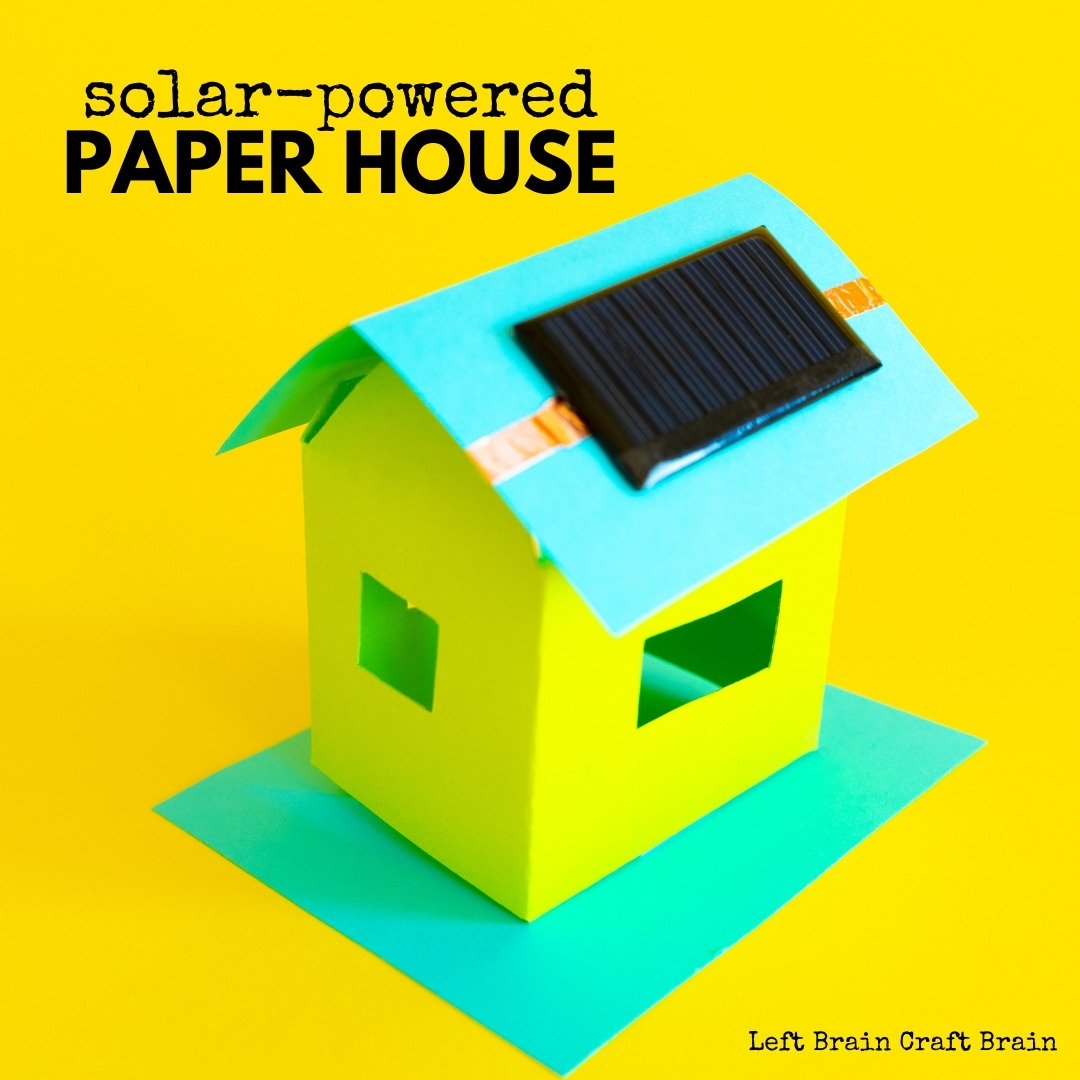


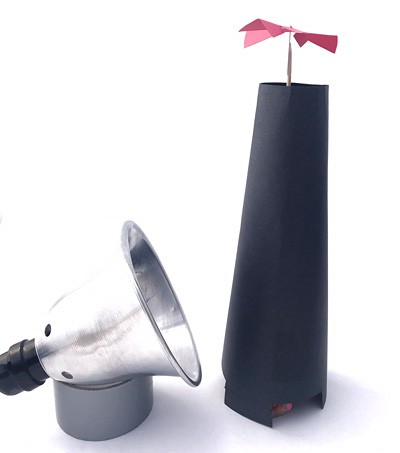

Some companies sell whole kits designed to teach kids about environmental engineering! If you have the money, these might make a great addition to a green makerspace ...
Thames & Kosmos Wind Power STEM Experiment Kit:
(Manufacturer Website)

Thames & Kosmos Hydropower STEM Experiment Kit:
(Manufacturer Website)

(Amazon)

(Amazon)

A few introductory books on green or sustainable engineering:
Children:
- Solar Story: How One Community Lives Alongside the World's Biggest Solar Plant, by Allan Drummond (2020)
- Description [from Goodreads]: In his signature style, Allan Drummond tells the story of the largest solar plant in the world, the Noor Solar Power Plant in Morocco's Sahara Desert, in Solar Story ―by relating it to the everyday life of a schoolgirl in a small village next to the plant. As we see on a class field trip, the plant is not only bringing reliable power to the village and far beyond, but is providing jobs, changing lives, and upending the old ways of doing things―starting within the girl's own family. Blending detail-filled watercolors, engaging cartoon-style narration, in-depth sidebars, and an afterword, the author showcases another real-world community going green in amazing ways. A “powerful” addition to the author’s acclaimed series about conservation and renewable energy innovations in everyday life.
- Energy Island: How One Community Harnessed the Wind and Changed Their World, by Allan Drummond (2011)
- Description [from Goodreads]: Meet the environmentally friendly people who now proudly call their home Energy Island. At a time when most countries are producing ever-increasing amounts of CO2, the rather ordinary citizens of Samsø have accomplished something extraordinary--in just ten years they have reduced their carbon emissions by 140% and become almost completely energy independent. A narrative tale and a science book in one, this inspiring true story proves that with a little hard work and a big idea, anyone can make a huge step towards energy conservation.
- The Boy Who Harnessed the Wind [Picture book version], by William Kamkwamba, Bryan Mealer, Elizabeth Zunon (Illustrator) (2012)
- Description [from Goodreads]: When fourteen-year-old William Kamkwamba's Malawi village was hit by a drought, everyone's crops began to fail. Without enough money for food, let alone school, William spent his days in the library ... and figured out how to bring electricity to his village. Persevering against the odds, William built a functioning windmill out of junkyard scraps, and thus became the local hero who harnessed the wind. Lyrically told and gloriously illustrated, this story will inspire many as it shows how—even in the worst of times—a great idea and a lot of hard work can still rock the world.
Teens:
- The Boy Who Harnessed the Wind [Young Reader version], by William Kamkwamba, Bryan Mealer, Anna Hymas (Illustrator) (2009)
- Description [from Goodreads]: When a terrible drought struck William Kamkwamba's tiny village in Malawi, his family lost all of the season's crops, leaving them with nothing to eat and nothing to sell. William began to explore science books in his village library, looking for a solution. There, he came up with the idea that would change his family's life forever: he could build a windmill. Made out of scrap metal and old bicycle parts, William's windmill brought electricity to his home and helped his family pump the water they needed to farm the land. Retold for a younger audience, this exciting memoir shows how, even in a desperate situation, one boy's brilliant idea can light up the world. Complete with photographs, illustrations, and an epilogue that will bring readers up to date on William's story, this is the perfect edition to read and share with the whole family.
- Engineering for Teens: A Beginner's Book for Aspiring Engineers, by Pamela McCauley (2021)
- Description [from Goodreads]: Explore engineering as a career with this introduction for ages 12 to 16. The job of an engineer is to solve all sorts of complex challenges facing the world while improving our lives through creative, innovative ideas. This engineering book for teens gives you a look into what engineers do and how they drive society forward through math and science. From designing tablets and smartphones to reimagining the way we collect and store renewable energy, this engineering book for teens introduces you to the major engineering disciplines and their distinct specialties, famous engineers throughout history, and more. Engineering fundamentals—Discover the four main branches of engineering and their different specialties. Inspired inventions—Get examples of the incredible things that engineers have created, like fuel cells and medicines. Inclusivity in engineering—Learn all about the diversity within the field of engineering. Discover the wonders of engineering and prepare yourself for a life of scientific discovery with this engineering book for teens.
Adults:
- Drawdown: The Most Comprehensive Plan Ever Proposed to Reverse Global Warming, edited by Paul Hawken (2017)
- Description [from Goodreads]: In the face of widespread fear and apathy, an international coalition of researchers, professionals, and scientists have come together to offer a set of realistic and bold solutions to climate change. One hundred techniques and practices are described here—some are well known; some you may have never heard of. They range from clean energy to educating girls in lower-income countries to land use practices that pull carbon out of the air. The solutions exist, are economically viable, and communities throughout the world are currently enacting them with skill and determination. If deployed collectively on a global scale over the next thirty years, they represent a credible path forward, not just to slow the earth’s warming but to reach drawdown, that point in time when greenhouse gases in the atmosphere peak and begin to decline. These measures promise cascading benefits to human health, security, prosperity, and well-being—giving us every reason to see this planetary crisis as an opportunity to create a just and livable world.
- The Boy Who Harnessed the Wind: Creating Currents of Electricity and Hope, by William Kamkwamba and Bryan Mealer (2009)
- Description [from Goodreads]: William Kamkwamba was born in Malawi, a country where magic ruled and modern science was mystery. It was also a land withered by drought and hunger, and a place where hope and opportunity were hard to find. But William had read about windmills in a book called Using Energy, and he dreamed of building one that would bring electricity and water to his village and change his life and the lives of those around him. His neighbors may have mocked him and called him misala—crazy—but William was determined to show them what a little grit and ingenuity could do. Enchanted by the workings of electricity as a boy, William had a goal to study science in Malawi's top boarding schools. But in 2002, his country was stricken with a famine that left his family's farm devastated and his parents destitute. Unable to pay the eighty-dollar-a-year tuition for his education, William was forced to drop out and help his family forage for food as thousands across the country starved and died. Yet William refused to let go of his dreams. With nothing more than a fistful of cornmeal in his stomach, a small pile of once-forgotten science textbooks, and an armory of curiosity and determination, he embarked on a daring plan to bring his family a set of luxuries that only two percent of Malawians could afford and what the West considers a necessity—electricity and running water. Using scrap metal, tractor parts, and bicycle halves, William forged a crude yet operable windmill, an unlikely contraption and small miracle that eventually powered four lights, complete with homemade switches and a circuit breaker made from nails and wire. A second machine turned a water pump that could battle the drought and famine that loomed with every season. Soon, news of William's magetsi a mphepo—his "electric wind"—spread beyond the borders of his home, and the boy who was once called crazy became an inspiration to those around the world.
- Sustainable Energy - Without the Hot Air, by David J. C. MacKay (2008)
- Description [from Goodreads]: Addressing the sustainable energy crisis in an objective manner, this enlightening book analyzes the relevant numbers and organizes a plan for change on both a personal level and an international scale--for Europe, the United States, and the world. In case study format, this informative reference answers questions surrounding nuclear energy, the potential of sustainable fossil fuels, and the possibilities of sharing renewable power with foreign countries. While underlining the difficulty of minimizing consumption, the tone remains positive as it debunks misinformation and clearly explains the calculations of expenditure per person to encourage people to make individual changes that will benefit the world at large. If you've thrown your hands up in despair thinking no solution is possible, then read this book - it's an honest, realistic, and humorous discussion of all our energy options.
- The Upcycle: Beyond Sustainability - Designing for Abundance, by William MacDonough and Michael Braungart
- Description [from Goodreads]: The Upcycle is the eagerly awaited follow-up to Cradle to Cradle, one of the most consequential ecological manifestoes of our time. Now, drawing on the green living lessons gained from 10 years of putting the Cradle to Cradle concept into practice with businesses, governments, and ordinary people, William McDonough and Michael Braungart envision the next step in the solution to our ecological crisis: We don't just use or reuse and recycle resources with greater effectiveness, we actually improve the natural world as we live, create, and build. For McDonough and Braungart, the questions of resource scarcity and sustainability are questions of design. They are practical-minded visionaries: They envision beneficial designs of products, buildings, and business practices—and they show us these ideas being put to use around the world as everyday objects like chairs, cars, and factories are being reimagined not just to sustain life on the planet but to grow it. It is an eye-opening, inspiring tour of our green future as it unfolds in front of us. The Upcycle is as ambitious as such classics as Rachel Carson's Silent Spring—but its mission is very different. McDonough and Braungart want to turn on its head our very understanding of the human role on earth: Instead of protecting the planet from human impact, why not redesign our activity to improve the environment? We can have a beneficial, sustainable footprint. Abundance for all. The goal is within our reach.
References:
Environmental Protection Agency. (2023). About green engineering. https://www.epa.gov/green-engineering/about-green-engineering
Jelting, U. (2016). Wind turbine [Photograph]. Wikimedia Commons. https://commons.wikimedia.org/wiki/File:Wind_Turbine_(184178167).jpeg
Office of Energy Efficiency & Renewable Energy. (n.d.). Renewable energy. U.S. Department of Energy. Retrieved November 7, 2023, from https://www.energy.gov/eere/renewable-energy
Comments
Post a Comment